HESI A2 math: what is covered
HESI A2 math covers fractions, percents, proportions, conversions, the 24-hour clock and Roman numerals. Your school decides if the calculator is on.

Short answer: HESI A2 math tests everyday arithmetic for nursing: whole numbers, fractions, decimals and percents, ratios and proportions, unit conversions, the 24-hour clock, Roman numerals and basic algebra, and at schools such as Tarrant County College and Germanna Community College it has 55 questions. Elsevier lets each school turn an on-screen calculator on or off, so ask your program; both of those schools say an on-screen calculator is available for math.
The topics
Elsevier's official Admission Assessment Exam Review has a Mathematics chapter with "step-by-step explanations and sample problems", but Elsevier's public pages do not list the math topics one by one. Germanna Community College's HESI A2 guide (updated January 2023) lists what its students should expect:
- adding, subtracting, multiplying and dividing whole numbers, fractions and decimals, including word problems,
- converting between decimals, fractions and percents,
- setting up and solving proportions,
- general unit conversion, "such as milliliters to ounces",
- converting between the 12-hour clock and military time,
- converting between Roman numerals and numbers,
- some basic algebra.
Many proportion questions read like simple medication problems: you know how much is in one unit and you work out how many units you need. That is the same reasoning used later in nursing school, at an easier level.
The calculator rule
Elsevier's HESI A2 faculty guide tells schools: "Use the toggle to enable/disable the calculator for students." So the calculator is the school's choice, not a fixed Elsevier rule.
Two school examples:
- Tarrant County College: "an on-screen calculator is available during testing" for math.
- Germanna Community College: "students may use a basic on-screen calculator to complete the math portion of the test".
Neither page mentions bringing your own calculator. Even with a calculator, set up each problem on paper first. The calculator does not tell you whether to multiply or divide.
Formula sheet
| Topic | Rule |
|---|---|
| Kilo | 1 kilogram (kg) = 1,000 grams (g). The National Institute of Standards and Technology (NIST) lists kilo as 10^3 |
| Milli | 1 g = 1,000 milligrams (mg). NIST lists milli as 10^-3, one thousandth |
| Length | 1 inch = 2.54 centimeters |
| Weight | 1 pound = 0.45 kilogram (approximate); 1 ounce = 28.35 grams |
| Volume | 1 fluid ounce = 29.57 milliliters (mL); 1 teaspoon = 4.93 mL; 1 tablespoon = 14.79 mL |
| Proportion | If a is to b as c is to x, then x = b times c, divided by a |
| Percent | Percent = part divided by whole, times 100 |
| 24-hour clock | After 12:00 noon, add 12 to the hour: 3:30 p.m. is 1530 |
| Roman numerals | I = 1, V = 5, X = 10, L = 50, C = 100. A smaller numeral before a larger one is subtracted: IV = 4, IX = 9 |
The conversions are NIST's approximate values. If a question gives you a conversion, use the one in the question.
Practice examples
These items show the style of question only. They are not HESI questions.
Example (written by All Nursing Exams): fractions and percents
Write 3/4 as a decimal and as a percent.
Answer: 3 divided by 4 = 0.75. As a percent, 0.75 times 100 = 75%.
Example (written by All Nursing Exams): proportion
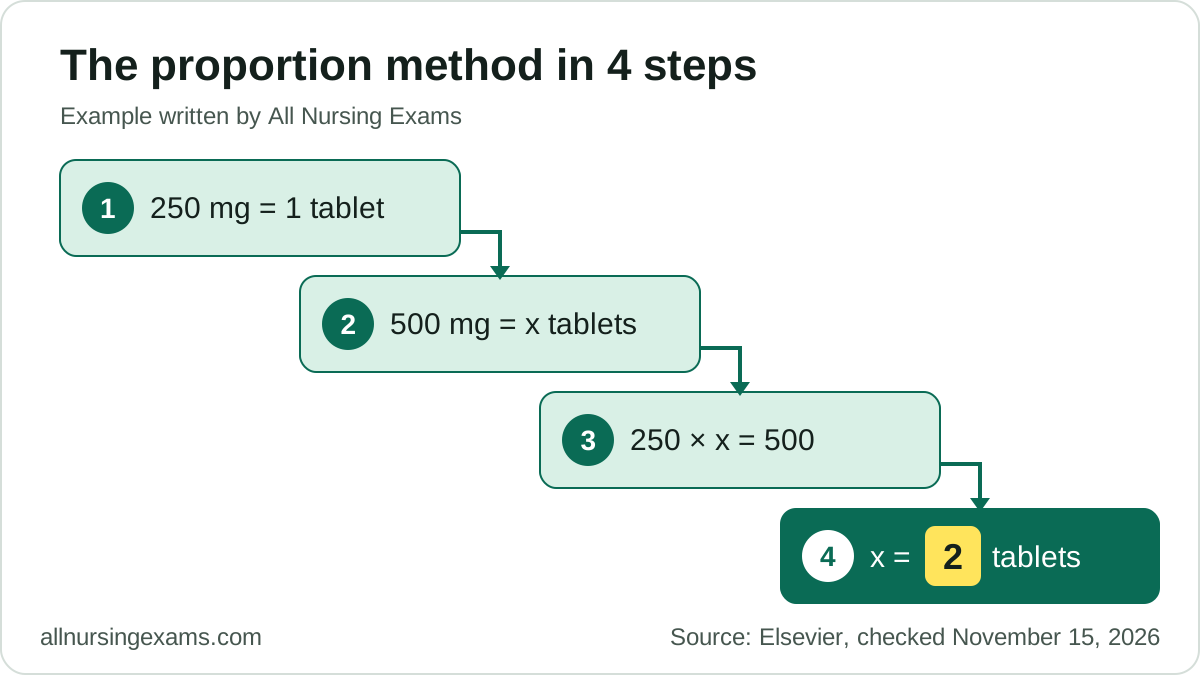
A tablet contains 250 mg. The order is 500 mg. How many tablets do you give?
Answer: Set up 250 mg is to 1 tablet as 500 mg is to x tablets. Cross multiply: 250 times x = 500. So x = 2 tablets.
Example (written by All Nursing Exams): conversion
A client weighs 154 pounds. Using 1 pound = 0.45 kg, what is the weight in kilograms?
Answer: 154 times 0.45 = 69.3 kg.
Two quick checks you can do the same way: 1530 hours is 3:30 p.m., and XIV is 14 (X = 10, then IV = 4).
How to study the math section
- Find out from your school whether the calculator will be on, and how many math questions you will get.
- Learn the formula sheet above until you can write it from memory.
- Practice fractions and proportions by hand, then check with a calculator.
- Read every word problem twice: once for the numbers, once for the unit the answer needs.
- Use the math chapter of Elsevier's review book and timed practice: see HESI A2 practice tests: official and free options.
What to do next
- Confirm that math is one of your school's required sections and note its minimum score.
- Practice one topic a day from the list above.
- Read HESI A2: the full guide for registration and scoring.
Common questions
Is algebra on the HESI A2 math section?
Germanna's guide says students should "complete some basic algebra problems". Expect simple equations, such as solving for x in a proportion.
Do I need to memorize conversions?
Yes, the common ones. A question may give you the conversion, but you save time if you know it.
Is HESI A2 math the same as dosage calculation in nursing school?
No. The A2 checks basic math before admission. Dosage calculation is taught and tested later by your program.
Sources
- Elsevier, HESI A2 exam process faculty guide: https://evolve.elsevier.com/education/hesi-a2-faculty-guide (checked November 15, 2026)
- Tarrant County College, HESI A2 exam information: https://www.tccd.edu/admission/testing-centers/hesi-a2/hesi-a2-exam-information/ (checked November 15, 2026)
- Germanna Community College, HESI A2 Nursing Entrance Exam Preparation Guide (updated January 2023): https://germanna.edu/sites/default/files/2025-07/HESI-A2-Nursing-Entrance-Exam-Preparation-Guide.pdf (checked November 15, 2026)
- NIST, Approximate Conversions from U.S. Customary Measures to Metric: https://www.nist.gov/pml/owm/approximate-conversions-us-customary-measures-metric (checked November 15, 2026)
- NIST, Metric (SI) Prefixes: https://www.nist.gov/pml/owm/metric-si-prefixes (checked November 15, 2026)
- Elsevier shop, Admission Assessment Exam Review, 6th edition, product page, read November 15, 2026