TEAS math: calculator rules and topics
TEAS 7 math has 38 questions (34 scored) in 57 minutes. Only ATI's basic on-screen calculator is allowed; no personal calculators.
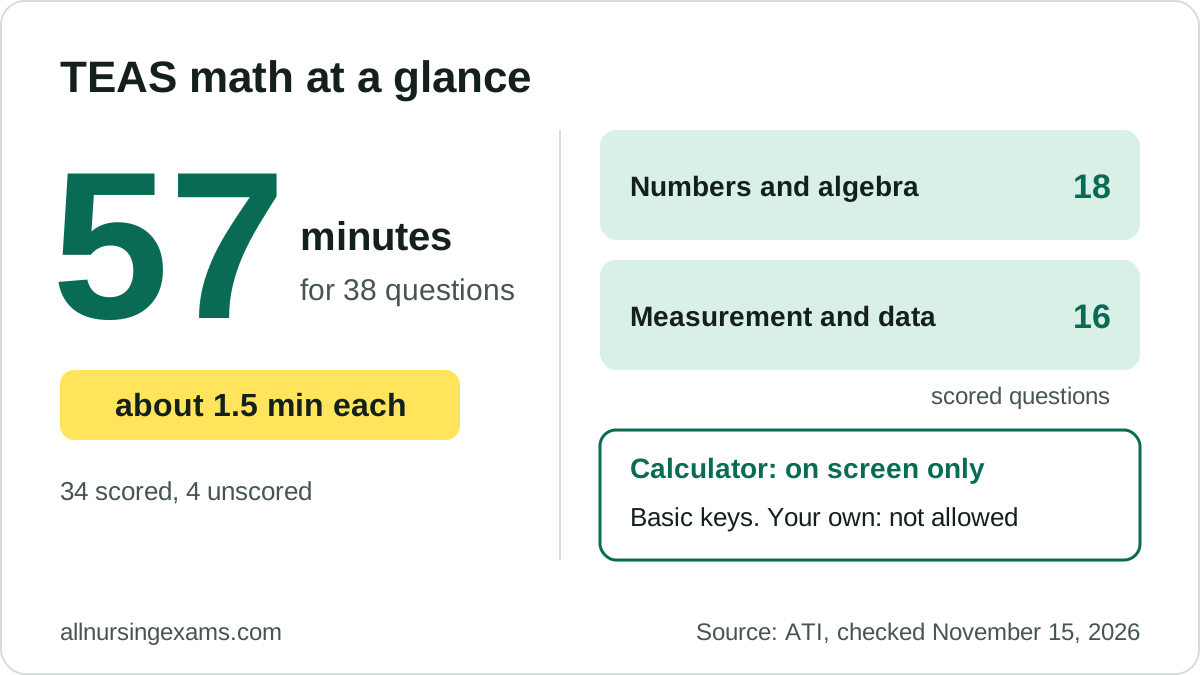
Short answer: The TEAS 7 math section has 38 questions (34 scored) in 57 minutes, split between numbers and algebra (18 scored questions) and measurement and data (16 scored questions). You may use only the basic calculator that ATI builds into the exam screen, and personal, phone and watch calculators are not allowed at home or in person.
Assessment Technologies Institute (ATI) writes the TEAS (Test of Essential Academic Skills). The facts below come from ATI's own pages, read on November 15, 2026. For the whole exam, see ATI TEAS 7: the full guide.
The math section in numbers
| Item | Math section |
|---|---|
| Questions | 38 |
| Unscored pretest questions | 4 |
| Scored questions | 34 (23% of all scored questions) |
| Time | 57 minutes |
| Time per question | About 1.5 minutes |
| Position | Second, after reading. An optional 10-minute break follows. |
You cannot tell which 4 questions are unscored, so answer all of them. There is no penalty for guessing, and a question left blank when time runs out counts as wrong.
The topics ATI lists
ATI's TEAS 7 content outline names two sub-areas and the skills under each.
Numbers and algebra (18 scored questions)
- Convert among fractions, decimals and percentages.
- Add, subtract, multiply and divide rational numbers, and compare and order them.
- Solve equations with one variable.
- Solve real-world problems with percentages, proportions, ratios and rates of change.
- Use estimation and rounding.
- Use expressions, equations and inequalities for real situations.
Measurement and data (16 scored questions)
- Read tables, charts and graphs.
- Use statistics to describe data sets.
- Explain the relationship between two variables.
- Calculate geometric quantities.
- Convert within and between the standard (US customary) and metric systems.
ATI's own blog lists two math topics among the 10 most missed TEAS topics: calculating geometric quantities, and converting between standard and metric units. Give those two extra practice.
The calculator rule
ATI provides a basic on-screen calculator. It opens from an icon next to the timer, and it is there on every question in every section, not only math.
- What it does: add, subtract, multiply, divide, percent, square root, a decimal point, a backspace key and memory keys. ATI says it is not a scientific or graphing calculator, and the math section is written with that in mind.
- What is banned: your own calculator, a phone calculator and a calculator watch. At a test site it must stay outside the room. In a remote exam, a calculator in view of the camera can be flagged.
- Paper version: ATI says very few schools still use it. If yours does, the proctor gives you a calculator.
- Scratch paper: one blank sheet of 8.5 by 11 inch paper or a small dry-erase board at home, plus two writing instruments. In-person centers provide the paper.
ATI says the on-screen calculator works differently from a handheld one. Practice with it before test day. ATI's free practice test uses the same calculator.
Worked examples by topic
These three items are our own. They show the style of question, not real TEAS items.
Example (written by All Nursing Exams): proportion
A patient receives 250 mL of fluid every 2 hours. At the same rate, how many mL does the patient receive in 7 hours? Type your answer.
Answer: 875 mL. Set up 250/2 = x/7. Cross-multiply: 2x = 1,750, so x = 875.
Example (written by All Nursing Exams): percentage
A textbook costs US$80. It is on sale for 15% off. What is the sale price?
A. US$12 B. US$65 C. US$68 D. US$92
Answer: C. 15% of 80 is 12, and 80 minus 12 is 68. Option A is the discount, not the price.
Example (written by All Nursing Exams): metric conversion
Convert 3.5 kilograms to grams.
Answer: 3,500 grams. One kilogram is 1,000 grams, so multiply by 1,000.
Weak-area checklist
Tick each line you can do quickly and correctly without notes:
- I can turn a fraction into a decimal and a percentage, and back again.
- I can solve a one-step and a two-step equation.
- I can set up a proportion from a word problem.
- I can find a percent increase or decrease.
- I can round to a given place and estimate an answer.
- I can read a value from a bar graph, line graph and table.
- I can find the mean, median, mode and range of a small data set.
- I can find the area and perimeter of a rectangle and a triangle, and the circumference of a circle.
- I can convert within the metric system and between metric and US units.
- I can use a basic on-screen calculator, including percent and memory keys.
Any line you cannot tick is your study list. Start with the sub-area that holds more questions: numbers and algebra.
What to do next
- Take a timed baseline practice test and note your math score and missed topics.
- Work through the checklist, starting with the lines you missed.
- Practice with a basic on-screen calculator, not a scientific one.
- Fit math into your weekly plan with our TEAS study schedule.
Common questions
Do I need to memorize formulas?
ATI's help center publishes a list of formulas to know, such as the area of a rectangle and the area of a triangle. Plan to know them before test day.
Can I go back to a math question?
Yes, while the math section is still open. You can flag questions and return to them. Once you submit the section, you cannot go back.
Is the math section different for nursing and allied health?
No. ATI gives everyone the same test. Only the comparison groups on the score report change.
Sources
- ATI, TEAS Exam Details: https://www.atitesting.com/teas/exam-details (checked November 15, 2026)
- ATI Help Center, What is the ATI TEAS Exam?: https://help.atitesting.com/what-is-the-ati-teas-exam/ (checked November 15, 2026)
- ATI, ATI TEAS Version 7 Content Outline: https://www.atitesting.com/docs/default-source/teas-resources/prior-teas-versions-(old)/assessments---ati-teas/ati_teas7_content_outline.pdf?sfvrsn=a043f912_4 (checked November 15, 2026)
- ATI Help Center, Can I use a calculator on the ATI TEAS exam?: https://help.atitesting.com/do-i-need-to-bring-a-calculator/ (checked November 15, 2026)
- ATI Help Center, What's the deal with the scratch paper?: https://help.atitesting.com/whats-the-deal-with-the-scratch-paper/ (checked November 15, 2026)
- ATI Help Center, What formulas do I need to know for the TEAS Exam?: https://help.atitesting.com/what-formulas-do-i-need-to-know-for-the-teas-exam/ (checked November 15, 2026)
- ATI Help Center, What are the ATI TEAS sections, and can I go back to a question?: https://help.atitesting.com/what-are-the-ati-teas-sections-and-can-i-go-back-and-answer-a-question/ (checked November 15, 2026)
- ATI Help Center, What is the difference between the Nursing vs. Allied Health TEAS exam?: https://help.atitesting.com/what-is-the-difference-between-the-nursing-vs-allied-health-teas-exam/ (checked November 15, 2026)
- ATI Nursing Blog, Top 10 Most Missed Topics on the ATI TEAS Exam (Version 7): https://atinursingblog.com/top-10-most-missed-topics-on-the-ati-teas-exam-version-7/ (checked November 15, 2026)
- ATI, Free ATI TEAS Practice Test page (ATI prep product), read November 15, 2026