HESI A2: the full guide
The HESI A2 is Elsevier's nursing admission exam. Your school picks the sections, calculator rule and passing score; one college tests 5 in 5 hours.

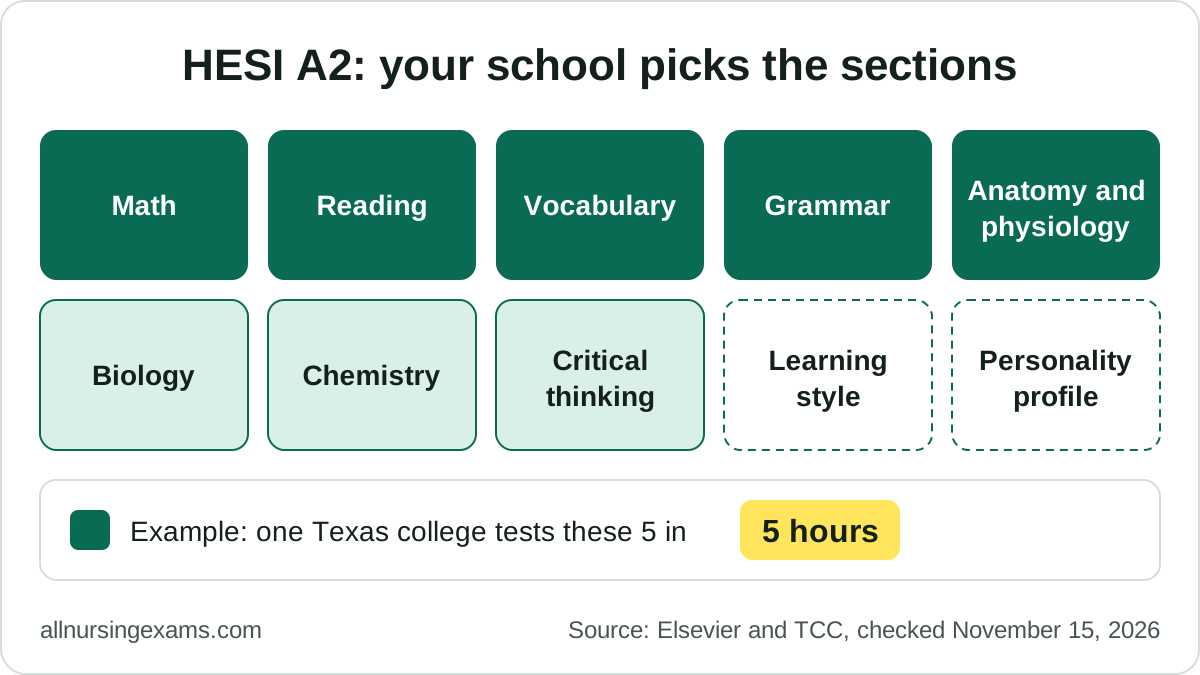
Short answer: The HESI A2 (HESI Admission Assessment) is Elsevier's computer-based entrance exam for nursing and health programs, and your school chooses which sections you take from math, reading comprehension, vocabulary, grammar, biology, chemistry, anatomy and physiology, critical thinking, a learning style profile and a personality profile. Elsevier does not publish one passing score or one fee: each program sets its own, for example Tarrant County College in Texas tests five sections in 5 hours for US$53 in person and requires 60 days between attempts.
At a glance
| Item | What applies |
|---|---|
| Made by | Elsevier (HESI) |
| Purpose | Helps a program decide whom to admit |
| Sections | Chosen by your school |
| Questions per section | Elsevier's public pages do not list them. Example, TCC: 55 for reading, vocabulary, grammar and math; 30 for anatomy and physiology |
| Time | Set when the school schedules the exam. Examples: TCC 5 hours; Germanna Community College four hours |
| Calculator | The school turns the on-screen calculator on or off |
| Scoring | Percent correct for each section; your program sets the passing score |
| Retakes | Set by your program. Examples: TCC 60 days between attempts; Germanna two attempts, 14 days apart |
| Fee | Set by the school or test site. Example, TCC: US$53 in person, US$75 online through ProctorU |
| Where | On campus or at a test site with a proctor, or online with a remote proctor, if your school offers it |
The examples come from each school's own page. Your school's rules are the ones that count.
Who takes the HESI A2
Applicants to nursing programs, both RN and PN, and to some health profession programs. Elsevier says the exam evaluates applicants "based on their existing level of knowledge on important areas in your program". It is an admission test only. It has no link to your license, which depends on the National Council Licensure Examination (NCLEX). For how the A2 fits with the other HESI exams, see What is the HESI exam?.
Which sections schools choose
Elsevier's faculty guide tells the school to "select the desired exam sections" when it schedules the exam. So two programs can give very different exams under the same name.
Academic sections. Elsevier's official review book covers seven subjects. This is what each one looks like, using Germanna Community College's description (January 2023) where Elsevier's public pages give no detail:
- Reading comprehension: passages where you find the main idea and supporting details, use context clues, tell fact from opinion, summarize and make inferences.
- Vocabulary: the meaning of general English and nursing words.
- Grammar: Elsevier's review book has a grammar chapter, but Elsevier's public pages list no grammar topics.
- Math: fractions, decimals, percents, proportions, unit conversion, the 24-hour clock, Roman numerals and basic algebra. See HESI A2 math: what is covered.
- Biology, chemistry, and anatomy and physiology: the science basics a program builds on. Germanna lists chemistry topics such as atomic structure, chemical equations, solutions and reactions.
Elsevier's review book has no physics chapter. If your school lists a physics section, ask what it covers.
Critical thinking. Elsevier's faculty guide lists A2 versions "with RN, PN, or HP Critical Thinking". The A2 itself is not program-specific, but the school picks the critical thinking version that matches its program.
Learning style and personality profiles. These appear in the menu of sections. TCC, for example, says it does not offer Biology, Chemistry, Personality Profile, Learning Styles or Critical Thinking. Elsevier's public pages do not explain how the two profiles are reported, so ask your program whether it uses them in admission.
How to register
You cannot register on your own through Elsevier. The path goes through your school or its test site.
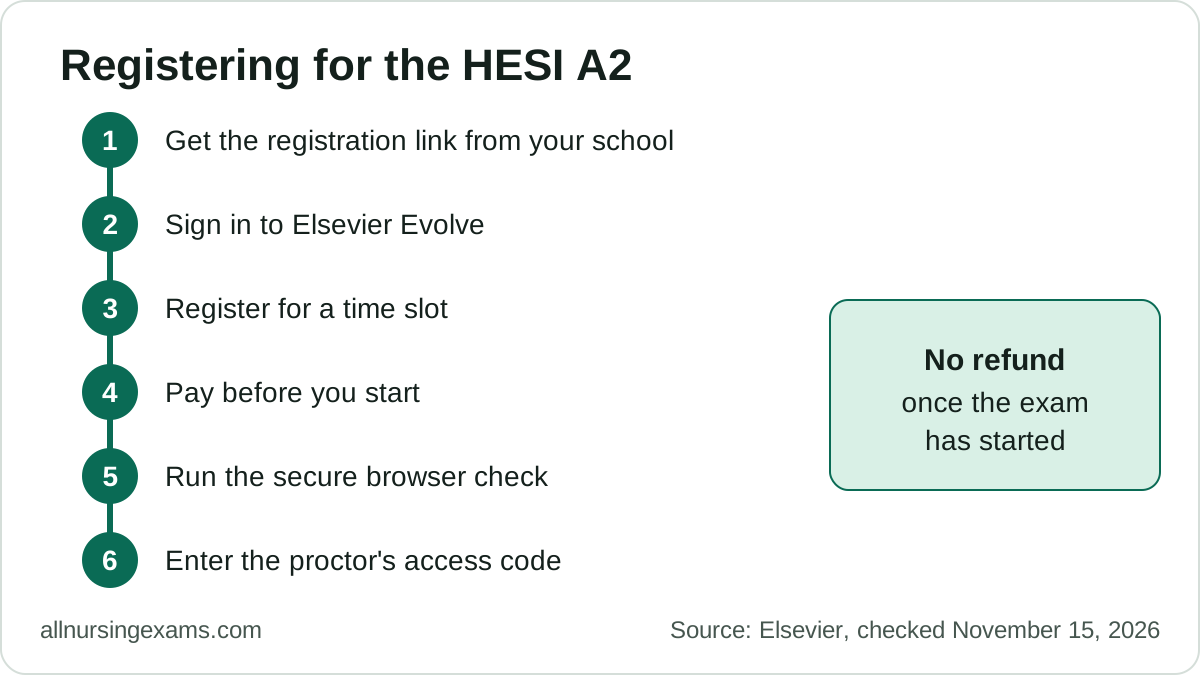
- Get the registration link. Elsevier's student guide says you must use "the registration link provided by your instructor or proctor". Some schools first ask you to book a date with their testing center.
- Sign in to Evolve. Use your Elsevier Evolve account or create one at evolve.elsevier.com.
- Register for your time slot. If you need another day, you can change to another open time slot.
- Pay if your school asks you to. Elsevier lets schools pay or bill students. You can pay any time before the exam, but you cannot start until you have paid. You cannot get a refund once you have started the exam.
- Check your device. For testing on your own device, run Elsevier's Compatibility Check and install the Elsevier Secure Browser. For TCC's online option, you also need a webcam, a microphone and a dry erase board.
- On test day, enter the access code. Your proctor gives you the code when the exam opens.
On test day
You choose a section from a "Select an Exam" screen. You can leave one section and start another, but Elsevier says that when you pause and leave the exam, "your timer will not stop". Elsevier says live proctoring is required for every HESI exam.
Some schools add their own rules. Germanna's guide says students cannot skip a question or go back to an earlier one, and that each section is scored before the next one starts. Ask your test site what to bring; TCC asks for a physical government-issued ID for in-person testing.
Scoring and results
Elsevier's faculty guide describes A2 results by "mean percent correct" and by the weakest subject areas, compared with a national average. Your school decides three things:
- When you see scores: after each section, after all sections, or not at all on screen.
- The benchmark for remediation: below it, Elsevier gives you study material for the concepts you missed.
- The admission minimum: the score the program accepts, overall or by section. Elsevier's public pages do not publish a passing score.
TCC says results are ready 48 to 72 hours after the test. You can view them in Evolve under Exam Results, and you can request a HESI transcript through Evolve if another program needs your scores.
Retakes and exam versions
Elsevier offers the A2 in a version 1 for first-time testers and a version 2 for second-time testers, so a retake can use a different version. The number of attempts and the wait between them are your program's rules, not Elsevier's. Check the dates against your application deadline before you book.
How to prepare
- Get your program's section list and minimum scores in writing.
- Use Elsevier's official review book for those sections: see HESI study guide: which one for which HESI exam?
- Practice under time with official and free tests: see HESI A2 practice tests: official and free options.
- Learn the math methods by hand, even if your school turns the calculator on.
- Never buy leaked questions. Elsevier says its test security team watches for posted exam content and issues takedown notices.
What to do next
- Write down your program's required sections, minimum scores, retake rule and deadline.
- Ask the testing center for the registration link and the fee.
- Book a test date that leaves room for one retake before your application deadline.
Common questions
Is the HESI A2 harder than the TEAS?
They are different exams from different companies, and your program usually accepts only one of them. Compare the section lists rather than the difficulty. The TEAS is covered in ATI TEAS 7: the full guide.
Do my scores transfer to another school?
You can request a HESI transcript through Evolve. Whether the other school accepts it, and how old the scores can be, is that school's decision.
Can I use my own calculator?
Ask your test site. Elsevier lets each school turn an on-screen calculator on or off, and TCC and Germanna both say an on-screen calculator is available for math. Neither page mentions a personal calculator.
Does the learning style profile affect admission?
Elsevier's public pages do not say. Ask your program.
Sources
- Elsevier, HESI exam solutions for nursing: https://www.elsevier.com/products/hesi/hesi-exam-solutions-nursing (checked November 15, 2026)
- Elsevier, HESI exam security: https://www.elsevier.com/products/hesi/exam-security (checked November 15, 2026)
- Elsevier, HESI A2 exam process faculty guide: https://evolve.elsevier.com/education/hesi-a2-faculty-guide (checked November 15, 2026)
- Elsevier, HESI A2 student guide: https://elsevierresources.com/nhe-student-training/wp-content/uploads/sites/61/2026/02/HESI-A2-Student-Guide-Personal-Devices.pdf (checked November 15, 2026)
- Tarrant County College, HESI A2 exam information: https://www.tccd.edu/admission/testing-centers/hesi-a2/hesi-a2-exam-information/ (checked November 15, 2026)
- Tarrant County College, Register for the HESI A2: https://www.tccd.edu/admission/testing-centers/hesi-a2/register-for-hesi-a2/index.html (checked November 15, 2026)
- Germanna Community College, HESI A2 Nursing Entrance Exam Preparation Guide (updated January 2023): https://germanna.edu/sites/default/files/2025-07/HESI-A2-Nursing-Entrance-Exam-Preparation-Guide.pdf (checked November 15, 2026)
- Elsevier shop, Admission Assessment Exam Review, 6th edition, product page, read November 15, 2026