ATI testing: what it is and how nursing schools use it
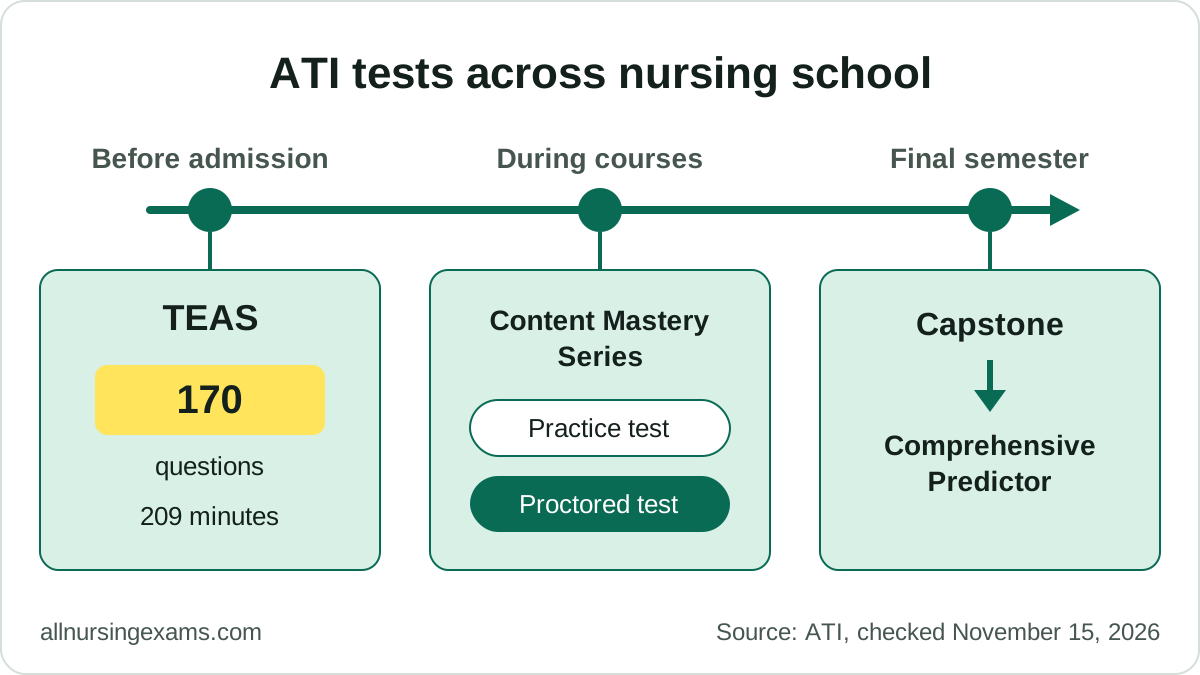
ATI gives the TEAS before admission (170 questions, 209 minutes), Content Mastery tests in courses and the Comprehensive Predictor before graduation.

Short answer: ATI (Assessment Technologies Institute) makes the tests many nursing schools give from admission to graduation: the TEAS entrance exam (170 questions in 209 minutes), Content Mastery Series practice and proctored assessments during courses, and the Capstone review and Comprehensive Predictor in the final semester. Your school, not ATI, decides which ATI tests you take and how much each score counts toward your grade or progression.
What ATI is
ATI is a company that builds nursing school tests. You get access through your school.
ATI says its Content Mastery Series is "designed to provide data related to a student's mastery of specific concepts related to the NCLEX". ATI tests show your school how ready you are for the National Council Licensure Examination (NCLEX). They are not the NCLEX, and they do not give you a license.
The ATI tests a student meets
| Test | When in school | What it measures |
|---|---|---|
| ATI TEAS (Test of Essential Academic Skills) | Before admission | Reading, math, science, English and language usage |
| Content Mastery Series practice assessment | During a course, before the proctored test | The same content area, for practice and review |
| Content Mastery Series proctored assessment | At the end of a course | One NCLEX content area, such as Fundamentals or Pharmacology |
| Capstone Content Review | Final semester | Weekly review by content area, with a pre and post assessment |
| RN or PN Comprehensive Predictor | Final semester | All NCLEX Client Needs categories, with a predicted chance of passing |
The TEAS. ATI describes the TEAS as "specifically designed for nursing program admissions". The exam has 170 questions and 209 minutes of testing time, and ATI says 20 of the 170 are unscored pretest questions. The full guide is ATI TEAS 7: the full guide.
The Content Mastery Series. ATI says each core content area has "a secure proctored and online practice assessment". Areas include Fundamentals, Pharmacology, Mental Health, Maternal Newborn and Adult Medical Surgical; ATI's page has the full RN and PN lists. After each test you get a "Focused Review" that points to the chapters to study.
Capstone. Capstone is a review in the final part of your program that prepares you for the Comprehensive Predictor. ATI says you take a proctored assessment before and after it, spend about 4 to 6 hours a week on it, and follow a set calendar with an ATI nurse educator.
The Comprehensive Predictor. ATI calls it "the last stop for students before they enter intensive NCLEX prep". The report shows your score, a "predicted probability of passing NCLEX", and your percent correct by topic.
Proficiency levels: what Level 1, 2 and 3 mean
Content Mastery Series proctored tests report a proficiency level. ATI sets a recommended cut score for each level on each test. In ATI's 2019 RN definitions:
- Level 1 meets "the absolute minimum expectations" for that content area.
- Level 2 can be considered to "exceed minimum expectations".
- Level 3 can be considered to "exceed most expectations".
ATI notes that a panel of nurse educators wrote these definitions and that no study then linked them to NCLEX-RN results. Treat a level as a review guide, not a forecast.
How schools tie ATI scores to grades
Each nursing program writes its own ATI policy, in the student handbook or course syllabus. Policies differ in how many points a test is worth, which level earns full points, whether you must finish practice tests first, and what happens below a benchmark, such as a retake or a study plan.
One example. At the Elaine Marieb College of Nursing at UMass Amherst, an ATI test is worth up to 5% of a course grade. Its policy splits that 5% into 1% for a practice test completed with a score of 80%, up to 3% for the proctored test, and 1% for remediation. Level 2 or 3 earns 3 points, Level 1 earns 2 points, and below Level 1 earns 1 point. Students take the RN Comprehensive Predictor within the first eight weeks of the final semester, and the stated benchmark is a 93% predicted chance of passing the NCLEX on the first try.
What a student sees
- You take a course's practice assessment, then use Focused Review.
- You take the proctored assessment on the date in your syllabus.
- You get a proficiency level and topics to review.
- In the final semester you may do Capstone, then the Comprehensive Predictor.
ATI says a dedicated security team protects its tests and that exam delivery is randomized. Elsevier says that Elsevier and ATI jointly won a preliminary injunction against the operators of Naxlex.com, which was accused of copying and selling their exam content. Do not buy or use leaked questions: they put your place in the program at risk.
What to do next
- Find your program's ATI policy and note how many points each test is worth.
- Take every practice assessment and use the Focused Review before the proctored test.
- If your school uses the HESI instead, read What is the HESI exam?.
Common questions
Is ATI the same as the NCLEX?
No. ATI tests are school tests made by a private company. The NCLEX is the licensing exam developed by the National Council of State Boards of Nursing (NCSBN). See the NCLEX-RN guide.
Can I fail a course because of an ATI score?
It depends on your program's policy. At UMass Amherst, for example, an ATI test is up to 5% of a course grade. Your handbook decides.
Do ATI scores count for my nursing license?
No. NCSBN says NCLEX results are what boards of nursing use to make licensure decisions. ATI scores stay with your school.
Sources
- ATI, TEAS exam details: https://www.atitesting.com/teas/exam-details (checked November 15, 2026)
- ATI, TEAS for educators: https://www.atitesting.com/educator/solutions/teas (checked November 15, 2026)
- ATI, Content Mastery Series: https://www.atitesting.com/educator/solutions/content-mastery-series (checked November 15, 2026)
- ATI, RN Content Mastery Series 2019 proficiency levels: https://www.atitesting.com/docs/default-source/assessments/rn-cms-2019/rn_2019_cms_prof_levels_20201230.pdf (checked November 15, 2026)
- ATI, Capstone Content Review: https://www.atitesting.com/educator/solutions/capstone-review (checked November 15, 2026)
- ATI, RN and PN Comprehensive Predictor: https://www.atitesting.com/educator/solutions/comprehensive-predictor (checked November 15, 2026)
- ATI, Exam security: https://www.atitesting.com/educator/about/exam-security (checked November 15, 2026)
- Elsevier, HESI exam security: https://www.elsevier.com/products/hesi/exam-security (checked November 15, 2026)
- NCSBN, NCLEX Examination Candidate Bulletin, April 2026: https://www.nclex.com/files/NCLEX_Examination_Candidate_Bulletin_April_2026.pdf (checked November 15, 2026)
- UMass Amherst Elaine Marieb College of Nursing, Appendix G, ATI testing policy: https://www.umass.edu/nursing/book/appendix-g-ati-testing-policy (checked November 15, 2026)