TEAS science section: what is tested
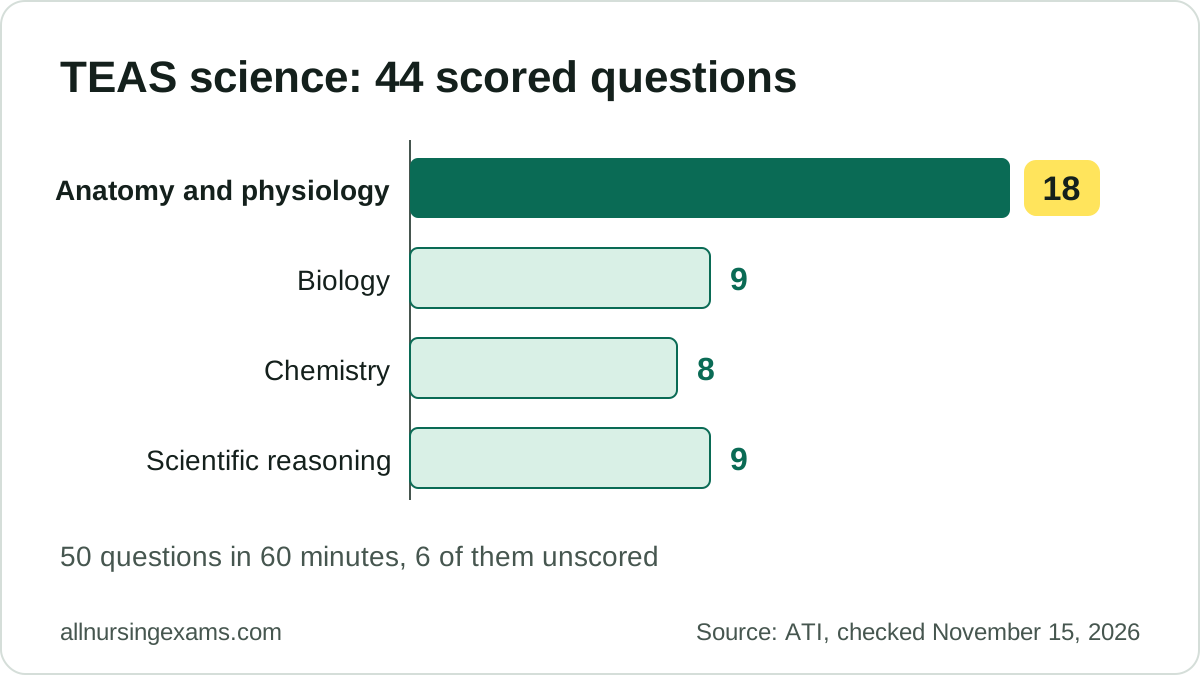
TEAS 7 science has 50 questions (44 scored) in 60 minutes: anatomy and physiology 18, biology 9, chemistry 8, scientific reasoning 9.

Short answer: The TEAS 7 science section has 50 questions (44 scored and 6 unscored) in 60 minutes, more questions than any other section. ATI splits the scored questions into human anatomy and physiology (18), biology (9), chemistry (8) and scientific reasoning (9).
Assessment Technologies Institute (ATI) writes the TEAS (Test of Essential Academic Skills). Facts on this page come from ATI's own pages, read on November 15, 2026. For the whole exam, see ATI TEAS 7: the full guide.
Science section facts
| Item | Science section |
|---|---|
| Questions | 50 |
| Unscored pretest questions | 6 |
| Scored questions | 44 (29% of all scored questions) |
| Time | 60 minutes |
| Time per question | About 1.2 minutes |
| Position | Third, right after the optional 10-minute break |
| Sub-area | Scored questions | Share of all scored questions |
|---|---|---|
| Human anatomy and physiology | 18 | 12% |
| Biology | 9 | 6% |
| Chemistry | 8 | 5% |
| Scientific reasoning | 9 | 6% |
Anatomy and physiology alone holds 18 of the 44 scored science questions, so it deserves more of your science study time than any other sub-area.
Which body systems get the most items?
ATI does not publish a question count for each body system. It gives 18 scored questions for anatomy and physiology as a whole. ATI's TEAS 7 content outline lists the objectives that "may be assessed": general orientation of human anatomy, plus 11 systems:
- respiratory
- cardiovascular
- digestive
- nervous
- muscular
- male and female reproductive
- integumentary (skin)
- endocrine
- urinary
- immune
- skeletal
Some systems are missed more often than others. ATI's own blog, updated February 2025 from ATI scoring data, lists three systems among the 10 most missed TEAS topics: the male and female reproductive system, the nervous system and the endocrine system. Treat these as priorities, but study every system on the list, because any of them can appear.
Biology, chemistry and scientific reasoning
ATI's outline lists these objectives.
- Biology (9 scored): cell structure and function; how genetic material relates to protein structure; Mendel's laws of inheritance; the basic macromolecules; the role of microorganisms in disease.
- Chemistry (8 scored): atomic structure; physical properties and changes of matter; chemical reactions; how conditions affect reactions; properties of solutions; acids and bases.
- Scientific reasoning (9 scored): scientific measurements and tools; using logic and evidence; predicting relationships among events, objects and processes; using the scientific method to interpret an investigation.
ATI's most-missed list includes four of these: describing chemical reactions (number 1 on the list), properties of solutions, predicting relationships, and the role of microorganisms in disease.
Study plan by sub-area
- Take a baseline. Use a timed practice test and record your score for each science sub-area.
- Anatomy and physiology first. Go system by system. For each one, learn the main structures and what they do, then how the system works with others, such as the nervous and endocrine systems.
- Biology next. Focus on cells, DNA and proteins, inheritance and microorganisms.
- Chemistry. Practice balancing equations and the basics of solutions, acids and bases. ATI says some science questions need a quick calculation, and the on-screen calculator is available.
- Scientific reasoning. Practice reading short experiments: name the variables, the control and what the results show.
- Retest and review. Take another timed practice test and spend your last week on the sub-areas that are still weak.
Three short examples follow. They are our own and show the style only.
Example (written by All Nursing Exams): biology
Which organelle makes most of a cell's ATP?
A. Nucleus B. Ribosome C. Mitochondrion D. Golgi apparatus
Answer: C. The mitochondrion carries out cellular respiration, which produces most ATP.
Example (written by All Nursing Exams): chemistry
A solution has a pH of 3. Is it acidic, neutral or basic?
Answer: acidic. A pH below 7 is acidic, 7 is neutral, and above 7 is basic.
Example (written by All Nursing Exams): scientific reasoning
A student tests whether the amount of light changes how tall bean plants grow. What is the independent variable?
A. Plant height B. Amount of light C. Type of soil D. Number of seeds
Answer: B. The independent variable is the one the student changes on purpose. Plant height is the dependent variable.
What to do next
- Take a baseline practice test and write down your four science sub-area scores.
- List the 11 body systems and rate yourself on each from weak to strong.
- Put anatomy and physiology into your weekly plan first, using our TEAS study schedule.
Common questions
Do I need math in the science section?
Sometimes. ATI says some science questions call for a quick calculation. The built-in calculator is available in every section. See TEAS math for the calculator rules.
Does ATI sell an anatomy and physiology practice test?
Yes. ATI includes a 70-question anatomy and physiology practice test in its paid packages. See ATI TEAS practice tests.
Is science before or after the break?
After. The optional 10-minute break comes after math, and the science clock starts only when you open the science section.
Sources
- ATI, TEAS Exam Details: https://www.atitesting.com/teas/exam-details (checked November 15, 2026)
- ATI Help Center, What is the ATI TEAS Exam?: https://help.atitesting.com/what-is-the-ati-teas-exam/ (checked November 15, 2026)
- ATI, ATI TEAS Version 7 Content Outline: https://www.atitesting.com/docs/default-source/teas-resources/prior-teas-versions-(old)/assessments---ati-teas/ati_teas7_content_outline.pdf?sfvrsn=a043f912_4 (checked November 15, 2026)
- ATI Nursing Blog, Top 10 Most Missed Topics on the ATI TEAS Exam (Version 7): https://atinursingblog.com/top-10-most-missed-topics-on-the-ati-teas-exam-version-7/ (checked November 15, 2026)
- ATI Help Center, Can I use a calculator on the ATI TEAS exam?: https://help.atitesting.com/do-i-need-to-bring-a-calculator/ (checked November 15, 2026)
- ATI Help Center, What are the ATI TEAS sections, and can I go back to a question?: https://help.atitesting.com/what-are-the-ati-teas-sections-and-can-i-go-back-and-answer-a-question/ (checked November 15, 2026)
- ATI, ATI TEAS Practice Test Package page (ATI prep product), read November 15, 2026