How to get CNA certification: the exam steps
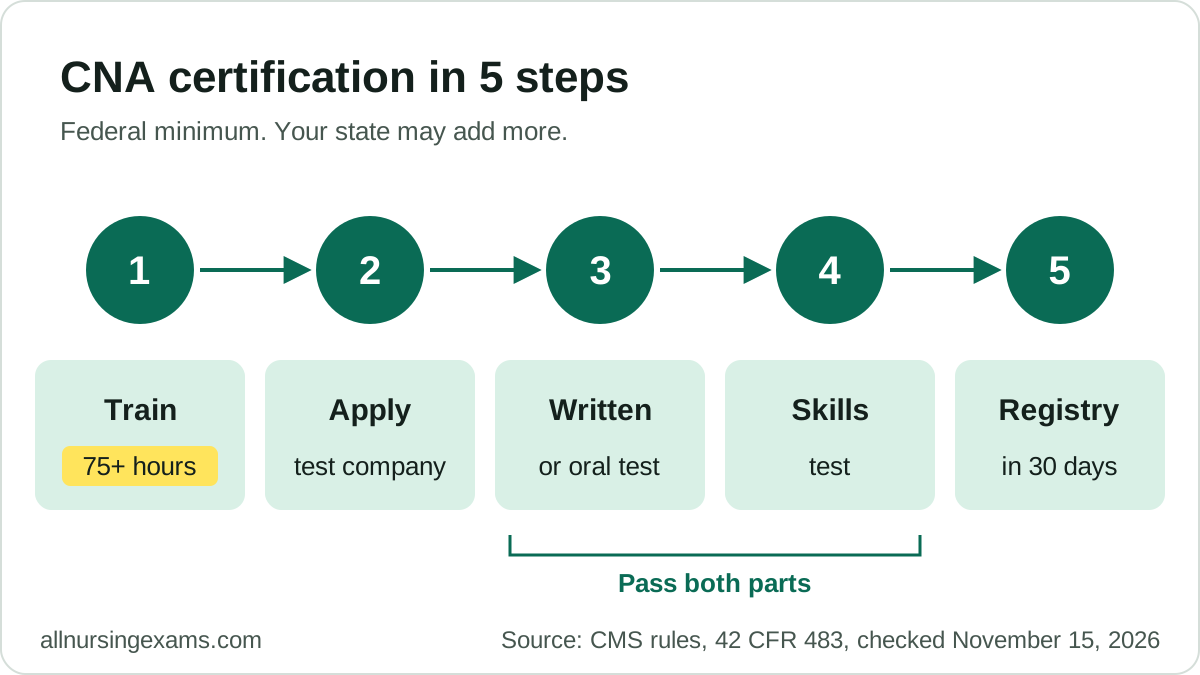
Finish a state-approved course of at least 75 hours, pass a written or oral test and a skills test, then get listed on your state's registry.
Short answer: To become a certified nursing assistant (CNA), you finish a state-approved training program of at least 75 clock hours, then pass both parts of your state's competency test: a written (or oral) test and a hands-on skills test. When you pass both, your state places you on its nurse aide registry, and federal rules say this must happen within 30 days.
The federal rules for nurse aides are in 42 CFR 483.152 to 483.156, set by the Centers for Medicare and Medicaid Services (CMS). Every state must meet them. Each state then adds its own rules, so the details below change from state to state.
Step 1: Finish a state-approved training program
Federal rules set the minimum. A training program must have:
- at least 75 clock hours of training in total;
- at least 16 hours of supervised practical training, done under a registered nurse (RN) or licensed practical nurse (LPN);
- at least 16 hours of classroom training before you touch a resident, covering communication, infection control, safety and emergency procedures (including the Heimlich maneuver), resident independence and residents' rights.
Many states require more than 75 hours. Three examples:
| State | Training required | Source |
|---|---|---|
| Federal minimum | 75 hours, 16 of them supervised practical | 42 CFR 483.152 |
| Texas | 100 hours: 60 classroom, 40 hands-on in a nursing facility | Texas Health and Human Services |
| California | 160 hours: 60 classroom, 100 supervised clinical | California Department of Public Health |
Your course must be on your state's approved list. Ask your state's nurse aide registry before you pay if you are not sure a course counts.
If a nursing home employs you, or has offered you a job, on the day you start training, federal rules say it cannot charge you for any part of the program, including textbooks. If you are hired by a nursing home within 12 months after you finish, the state must arrange pro rata reimbursement of your costs.
Step 2: Apply to your state's test company
Federal rules let a state give the test itself or approve another organization to give it. Most states use a testing company, and you apply and pay through that company. The three main companies are Credentia (which runs the National Nurse Aide Assessment Program, or NNAAP), Prometric, and D&S Diversified Technologies (Headmaster). See CNA state exam: who runs it in your state for examples.
Fees are set by each state and company. North Carolina charges US$140 for both parts through Credentia. Florida charges US$155 through Prometric. Some states also require a background check: Florida, for example, requires a Level II background screening and fingerprints.
Step 3: Pass the written or oral test
Federal rules say you must be allowed to choose a written test or an oral test, where the questions are read to you. The questions come from a larger pool, and the state must keep that pool and each test confidential.
The length depends on the company. The NNAAP written test has 70 multiple-choice items and a 2-hour limit. Prometric's written test in Florida and Texas has 60 questions and 90 minutes. The full breakdown is in CNA test: what the written and skills parts cover.
Step 4: Pass the skills test
In the skills test, you perform real nurse aide tasks in front of an evaluator. Federal rules say the skills are chosen at random and the evaluator must be an RN with at least one year of experience caring for older or chronically ill people. On the NNAAP you perform 5 skills in 30 minutes, and hand hygiene is always one of them. The possible skills are listed in CNA skills list.
You must pass both parts. Federal rules give you at least three attempts. Many states also set a time limit: North Carolina and Ohio require you to pass within two years of finishing training.
Step 5: Get listed on the nurse aide registry
When you pass both parts, the state adds you to its nurse aide registry. This listing is your certification. Federal rules say it must happen within 30 days. In North Carolina, Credentia says to allow 2 to 5 business days. Florida's bulletin says 3 to 5 weeks after the Board of Nursing approves you.
Before a nursing home lets you work as a nurse aide, it must check the registry. To keep your listing active, you must keep working: see CNA registry: how to get listed and stay active.
What to do next
- Find your state's nurse aide registry or health department page and read its rules for training hours and testing.
- Choose a training program on your state's approved list.
- Download the candidate handbook from your state's test company and read the skills list early.
- Ask a nursing home employer whether it pays for training, since federal rules may cover your costs.
Common questions
Can I skip training and just take the test?
Some states allow it, many do not. Florida has a "Challenger" route for people with no training, but after three failed attempts you must complete a state-approved program of at least 120 hours.
Is CNA certification the same in every state?
No. The federal minimum is the same, but each state sets its own training hours, fees, time limits and test company. Moving to a new state usually means applying to that state's registry.
Do I need to renew my CNA certification?
Yes, in most states. Federal rules remove you from the registry after 24 consecutive months without paid nursing-related work.
Sources
- eCFR, 42 CFR 483.152, Requirements for approval of a nurse aide training and competency evaluation program: https://www.ecfr.gov/current/title-42/chapter-IV/subchapter-G/part-483/subpart-D/section-483.152 (checked November 15, 2026)
- eCFR, 42 CFR 483.154, Nurse aide competency evaluation: https://www.ecfr.gov/current/title-42/chapter-IV/subchapter-G/part-483/subpart-D/section-483.154 (checked November 15, 2026)
- eCFR, 42 CFR 483.156, Registry of nurse aides: https://www.ecfr.gov/current/title-42/chapter-IV/subchapter-G/part-483/subpart-D/section-483.156 (checked November 15, 2026)
- eCFR, 42 CFR 483.35, Nursing services: https://www.ecfr.gov/current/title-42/chapter-IV/subchapter-G/part-483/subpart-B/section-483.35 (checked November 15, 2026)
- NCSBN, NNAAP and MACE: https://www.ncsbn.org/exams/nnaap-and-mace.page (checked November 15, 2026)
- Texas Health and Human Services, Nurse Aide Training and Competency Evaluation Program (NATCEP): https://www.hhs.texas.gov/business/licensing-credentialing-regulation/long-term-care-credentialing/nurse-aide-training-competency-evaluation-program-natcep (checked November 15, 2026)
- California Department of Public Health, Nurse Assistant Training Program Applicants: https://www.cdph.ca.gov/Programs/CHCQ/LCP/Pages/Nurse-Assistant-Training-Program-Applicants.aspx (checked November 15, 2026)
- Prometric, Florida CNA Candidate Information Bulletin: https://www.prometric.com/files/Nurse-Aide/FL-CNA-CIB.pdf (checked November 15, 2026)
- Prometric, Florida Nurse Aide Exam: https://www.prometric.com/exams/nurseaide-fl/ (checked November 15, 2026)
- Credentia, North Carolina NNAAP handbook, Exam Fees: https://kb-ncna.credentia.com/en/article/exam-fees (checked November 15, 2026)
- Credentia, North Carolina NNAAP handbook, Exam Overview: https://kb-ncna.credentia.com/en/article/exam-overview-updated (checked November 15, 2026)
- Credentia, North Carolina NNAAP handbook, Eligibility Criteria: https://kb-ncna.credentia.com/en/article/eligibility-criteria (checked November 15, 2026)
- Credentia, North Carolina NNAAP handbook, The Registry: https://kb-ncna.credentia.com/en/article/the-registry (checked November 15, 2026)
- D&S Diversified Technologies (Headmaster), Ohio Nurse Aide Candidate Handbook, December 2025: https://hdmaster.com/assets/oh-candidate-handbook-10.19.26.pdf (checked November 15, 2026)