CNA skills list: the skills on the skills test
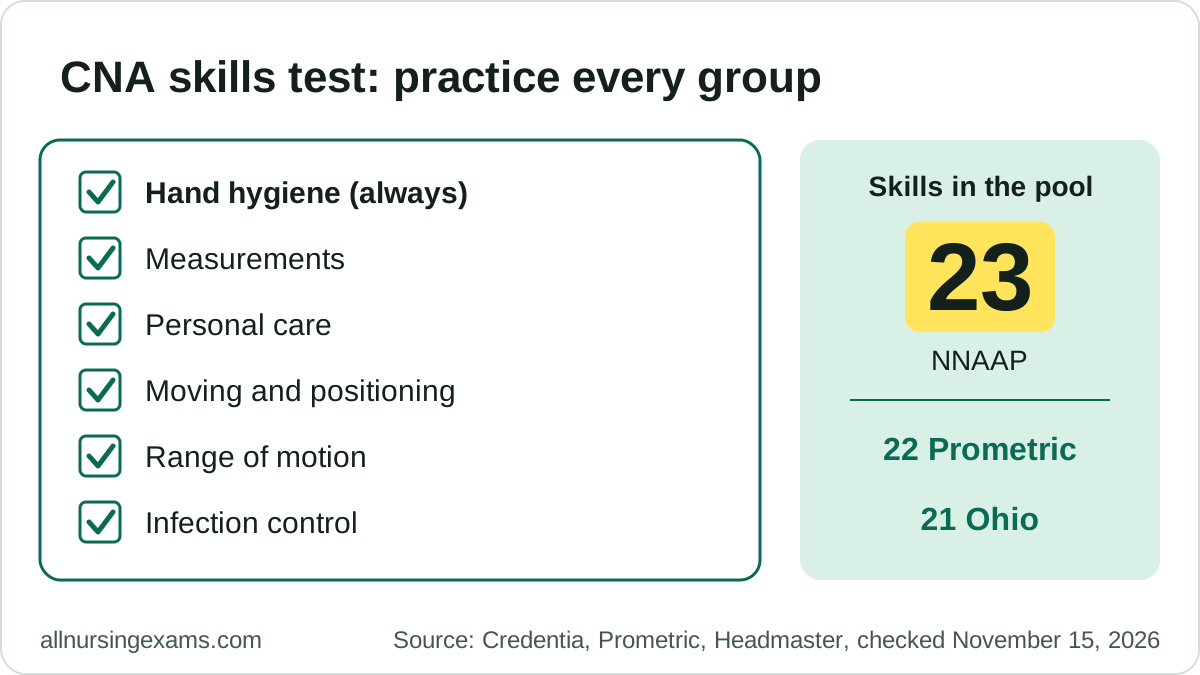
NNAAP draws 5 of 23 skills, Prometric scores 5 from a pool of 22, and Ohio's Headmaster test lists 21 tasks; hand washing is always tested.
Short answer: The skills that can appear depend on your state's test company: the National Nurse Aide Assessment Program (NNAAP) lists 23 skills and you perform 5 of them, Prometric's Clinical Skills Test has a pool of 22 skills, and Ohio's Headmaster test lists 21 tasks. Hand washing is tested in all three, and missing a critical step fails the skill.
Below is a summary in our own words. The step-by-step lists belong in your official candidate handbook, which is free. Always practice from your own state's handbook, because the steps and the scoring differ.
Why the skills are random
Federal rules (42 CFR 483.154) say the skills test must use randomly selected tasks from a pool of tasks that nurse aides usually perform. The pool must include all the personal care skills from the federal training curriculum: bathing, grooming including mouth care, dressing, toileting, eating and hydration, feeding, skin care, and transfers, positioning and turning. So you must be ready for every skill on your company's list.
The skills, grouped
| Skill group | NNAAP (Credentia) | Prometric | Headmaster (Ohio) |
|---|---|---|---|
| Hand hygiene | Hand hygiene, always one of your 5 skills | Handwashing, always scored | Hand washing built into the first task |
| Measurements | Radial pulse; respirations; electronic blood pressure; manual blood pressure; urinary output; weight | Pulse; respirations; measure urine | Pulse and respirations; output with a bedpan or drainage bag |
| Personal care | Modified bed bath; mouth care; denture care; foot care; perineal care (female); catheter care (female); dressing with a weak arm; feeding; bedpan | Partial bed bath; mouth care (teeth or denture); foot care; hand and nail care; perineal care; catheter care; dressing; feeding; bedpan | Partial bed bath; teeth and denture care; hair care; nail care; perineal care; brief change; catheter care; dressing; feeding in bed; bedpan |
| Moving and positioning | Walking with a transfer belt; bed to wheelchair with a transfer belt; positioning on side | Ambulation; transfer; change position | Walking with a gait belt, with or without a walker; stand and pivot transfer; positioning on side |
| Range of motion | Knee and ankle; shoulder | Hip, knee and ankle; elbow and wrist; shoulder | Hip and knee; shoulder |
| Infection control and other | Putting on and removing a gown and gloves; one knee-high elastic stocking | Indirect Care (always scored); change an occupied bed | Gown, gloves and eye protection; anti-embolic stocking; make an occupied bed |
In Prometric's test you are scored on Handwashing and Indirect Care plus 3 assigned skills. Indirect Care covers the resident's rights and preferences, communication, safety, comfort and infection control during every skill. In Ohio you get 3 or 4 tasks, and the first is one of five mandatory tasks with hand washing built in.
Critical steps: the steps that fail a skill
Each skill has a few steps that matter most.
- Credentia (NNAAP): "Critical Element Steps" are in bold in the handbook. If you do not complete one correctly, you fail that skill.
- Headmaster (Ohio): key steps are in bold. You must do every key step and at least 80% of the other steps on each task.
- Prometric: each skill has checkpoints. Prometric says you do not have to be perfect, but you must show competency. Two nurses watch you in Florida.
On Prometric and Ohio tests, one failed skill means a failed skills test, because you must pass every skill you are given.
A practice checklist for each skill group
These are habits that training programs teach, in our own words. Use them with the official steps from your handbook, not instead of them, and follow your handbook where it differs.
- Every skill: knock, introduce yourself, explain what you will do, give privacy, and speak to the resident by name the whole time. Say aloud when you would wash your hands.
- Hand hygiene: practice until you can do it without thinking, including the timing your handbook gives.
- Measurements: count for the full time your handbook states, then write the number on the recording form. Credentia says you must perform the measurement and record it correctly.
- Personal care: gather supplies first, check water temperature where the skill uses water, and keep the resident covered.
- Moving and positioning: lock wheels, apply the belt correctly, and keep the resident's body aligned.
- Range of motion: move each joint gently, support it above and below, and stop if the resident reports pain.
- Infection control: practice putting on and removing the gown and gloves in your handbook's exact order.
Practice each skill in the time you will have: 30 minutes for 5 NNAAP skills, 31 to 40 minutes on a Prometric test, and 35 minutes in Ohio.
What to do next
- Download your state's candidate handbook and print the skills list.
- Practice with a partner who reads the steps and marks what you miss.
- Read CNA test: what the written and skills parts cover for the time and pass rules.
Common questions
Will I know my skills before test day?
Prometric says the computer assigns your skills when you are scheduled, but you learn them when you get the instructions at the test. Credentia gives you an instruction card at the test, and you must perform the skills in that order.
Do I need to bring my own gait belt?
No. Credentia tells candidates not to bring their own equipment, such as transfer belts.
What if I make a mistake during a skill?
Tell the evaluator and do the step again. Once you start a new skill, you cannot go back.
Sources
- eCFR, 42 CFR 483.152, Requirements for approval of a nurse aide training and competency evaluation program: https://www.ecfr.gov/current/title-42/chapter-IV/subchapter-G/part-483/subpart-D/section-483.152 (checked November 15, 2026)
- eCFR, 42 CFR 483.154, Nurse aide competency evaluation: https://www.ecfr.gov/current/title-42/chapter-IV/subchapter-G/part-483/subpart-D/section-483.154 (checked November 15, 2026)
- Credentia, North Carolina NNAAP handbook, Skills: https://kb-ncna.credentia.com/en/article/skills (checked November 15, 2026)
- Credentia, North Carolina NNAAP handbook, The Skill Evaluation: https://kb-ncna.credentia.com/en/article/the-skill-evaluation (checked November 15, 2026)
- Credentia, North Carolina NNAAP handbook, Exam Overview: https://kb-ncna.credentia.com/en/article/exam-overview-updated (checked November 15, 2026)
- Prometric, Florida CNA Candidate Information Bulletin: https://www.prometric.com/files/Nurse-Aide/FL-CNA-CIB.pdf (checked November 15, 2026)
- Prometric, Clinical Skills Test Checklist: https://www.prometric.com/files/FL_CNA_ClinicalSkillsChecklist.pdf (checked November 15, 2026)
- Prometric, Clinical Skills Timing Study: https://www.prometric.com/files/SummaryClinicalSkillsTiming.pdf (checked November 15, 2026)
- D&S Diversified Technologies (Headmaster), Ohio Nurse Aide Candidate Handbook, December 2025: https://hdmaster.com/assets/oh-candidate-handbook-10.19.26.pdf (checked November 15, 2026)