What is an LPN? License, exam and scope
An LPN (LVN in some states) is a nurse licensed by a state board after a state-approved program and the NCLEX-PN; each state sets what an LPN may do.

Short answer: A licensed practical nurse (LPN) is a nurse licensed by a state board of nursing to give basic nursing care, and in some states, such as Texas and California, the same role is called a licensed vocational nurse (LVN). To get the license you finish a state-approved program and pass the NCLEX-PN (85 to 150 questions in up to five hours), and what an LPN may do, including how closely an LPN is supervised, is set by each state.
LPN or LVN: the same role, two titles
The US Bureau of Labor Statistics (BLS) says: "Responsibilities for LPNs and LVNs are nearly identical; their title depends on the state in which they work." Two examples:
- Texas uses the vocational nurse title. Its Board of Nursing tells "LVN/LPN graduates" to apply with the NCLEX-PN application.
- California licenses vocational nurses through a separate board, the Board of Vocational Nursing and Psychiatric Technicians. It says there are five different methods to qualify for an LVN license in California.
The National Council of State Boards of Nursing (NCSBN) uses the combined term "LPN/VN" in its exam documents.
The license and the exam
Every US board of nursing uses the National Council Licensure Examination for Practical Nurses (NCLEX-PN). NCSBN says boards use it because each one requires "passing an examination that measures the competencies needed to perform safely and effectively as a licensed practical/vocational nurse (LPN/VN)".
Key facts from NCSBN:
- It is a computerized adaptive test of 85 to 150 items, with a five-hour limit that includes breaks.
- Each exam includes 18 case study items and 15 unscored pretest items.
- The current test plan runs from April 1, 2026 through March 31, 2029.
- It is used for US licensure only.
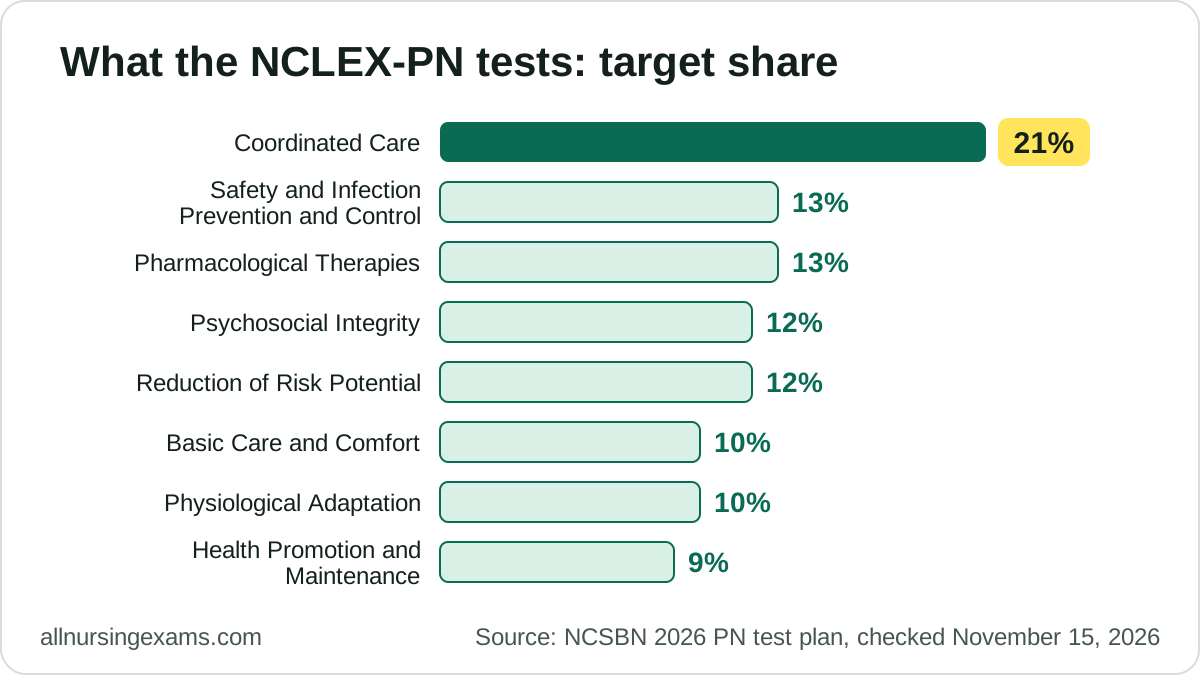
NCSBN's test plan describes the entry-level LPN/VN as able to care for clients "with commonly occurring health problems that have predictable outcomes". The test plan's target share of items by content area:
| Client Needs category | Range | Target |
|---|---|---|
| Coordinated Care | 18 to 24% | 21% |
| Safety and Infection Prevention and Control | 10 to 16% | 13% |
| Health Promotion and Maintenance | 6 to 12% | 9% |
| Psychosocial Integrity | 9 to 15% | 12% |
| Basic Care and Comfort | 7 to 13% | 10% |
| Pharmacological Therapies | 10 to 16% | 13% |
| Reduction of Risk Potential | 9 to 15% | 12% |
| Physiological Adaptation | 7 to 13% | 10% |
NCSBN says a single exam may differ from these shares by up to 3% in each category. For the route from school to test day, see LPN programs: from enrollment to the NCLEX-PN.
Scope of practice: set by each state
Scope of practice means what a nurse is allowed to do. For LPNs it is not the same everywhere. NCSBN says safe nursing practice "is grounded in the law as written in the state nurse practice act (NPA) and the state rules/regulations". BLS gives three examples of how states differ:
- "In some states, licensed practical and licensed vocational nurses can give medication or start intravenous (IV) drips."
- "States determine the extent to which LPNs and LVNs must be directly supervised."
- "Some states allow experienced LPNs and LVNs to oversee other LPNs and LVNs or unlicensed medical staff."
So a task that one state allows may not be allowed in another. Use NCSBN's "Find Your Nurse Practice Act" tool to open your state's law, and read your board's own scope pages. This page is not legal advice; ask your board if you are unsure.
What LPNs do day to day
BLS lists typical duties, including:
- checking blood pressure, temperature and other vital signs,
- basic care and comfort, such as changing bandages and helping with bathing or dressing,
- talking with patients about their care,
- reporting patients' status "to registered nurses, advanced practice nurses, or physicians",
- documenting care.
Job facts from BLS
| Measure | LPNs and LVNs |
|---|---|
| Typical entry-level education | Postsecondary nondegree award |
| Program length | About 1 year (certificate or diploma) |
| Median pay, May 2025 | US$64,400 per year (US$30.96 per hour) |
| Jobs in 2025 | 666,900 |
| Projected growth, 2025 to 2035 | 3%, as fast as average |
What to do next
- Find your state board through NCSBN's directory and read its LPN or LVN licensing page.
- Check that any program you consider is approved by that board.
- If you plan to become a registered nurse later, read LPN vs RN: license, exam and scope compared.
Common questions
Is an LPN a registered nurse?
No. An LPN holds a practical or vocational nurse license and passed the NCLEX-PN. A registered nurse (RN) holds a different license and passes the NCLEX-RN.
Can an LPN become an RN?
Yes. BLS says "an LPN may complete an LPN-to-RN education program to become a registered nurse". You then take the NCLEX-RN.
Is the NCLEX-PN used in Canada?
No. NCSBN says the NCLEX-PN is used for US licensure only.
Sources
- NCSBN, 2026 NCLEX-PN Test Plan: https://www.nclex.com/files/2026_PN_Test%20Plan-F.pdf (checked November 15, 2026)
- NCSBN, NCLEX test plans: https://www.nclex.com/test-plans.page (checked November 15, 2026)
- NCSBN, NCLEX Examination Candidate Bulletin, April 2026: https://www.nclex.com/files/NCLEX_Examination_Candidate_Bulletin_April_2026.pdf (checked November 15, 2026)
- NCSBN, Internationally educated nurses (all US boards use the NCLEX-RN and NCLEX-PN): https://www.ncsbn.org/nursing-regulation/licensure/internationally-educated-nurses.page (checked November 15, 2026)
- NCSBN, Find Your Nurse Practice Act: https://www.ncsbn.org/npa (checked November 15, 2026)
- NCSBN, Contact a U.S. Member: https://www.ncsbn.org/contactbon (checked November 15, 2026)
- Texas Board of Nursing, licensure by examination: https://www.bon.texas.gov/licensure_examination.asp.html (checked November 15, 2026)
- California Board of Vocational Nursing and Psychiatric Technicians, applicants: https://www.bvnpt.ca.gov/applicants/index.html (checked November 15, 2026)
- US Bureau of Labor Statistics, Occupational Outlook Handbook, Licensed Practical and Licensed Vocational Nurses: https://www.bls.gov/ooh/healthcare/licensed-practical-and-licensed-vocational-nurses.htm (checked November 15, 2026)